 NATIONS ROYALE
Play free
The complete guide
How to play Nations Royale
Nations Royale is a real-time war for the whole world. You pick a nation, send troops from province to province, and win by holding 70% of the map. A war takes a few minutes on a small board and longer on the world map. It's free and runs in any browser, on a phone or a computer.
This guide covers every rule in the game. If you only want the short version, it's three steps: pick a nation, send troops, hold 70% of the world. The rest of this page explains how each of those works and what changes the result.
The basics
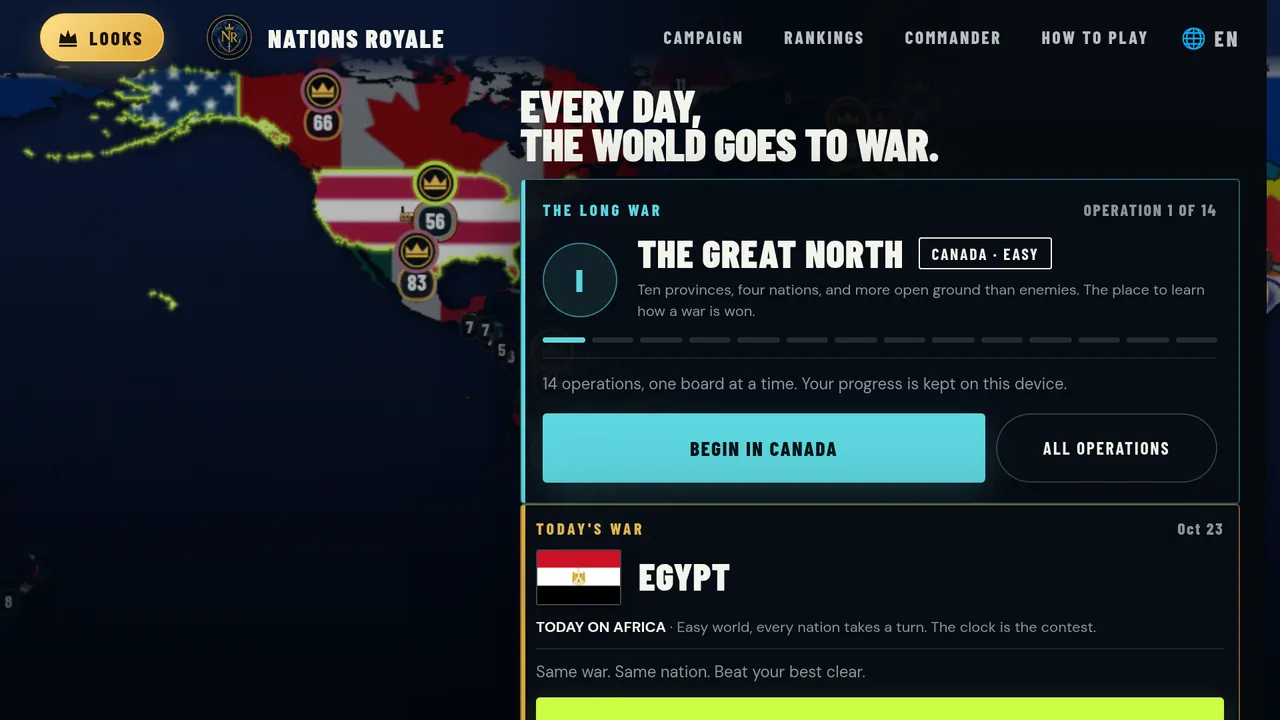
Every war starts with you holding one province: your home country, which is also your capital. Every other province on the map is either another nation or neutral ground.
- Rival nations are run by AI commanders. They expand, attack each other, and attack you.
- Neutral provinces have a faded flag. They're lightly held and they never attack anyone, so they're the free ground everybody races to take in the first minute.
- Troops refill over time in every province, up to a cap. Big countries have bigger caps, but not in proportion to their size: Russia holds a lot more than Albania, not hundreds of times more.
The world map has 139 provinces and 48 nations you can play. The other provinces are neutral. Smaller boards, like Europe or the United States, work the same way with fewer provinces. See the maps.
How you win
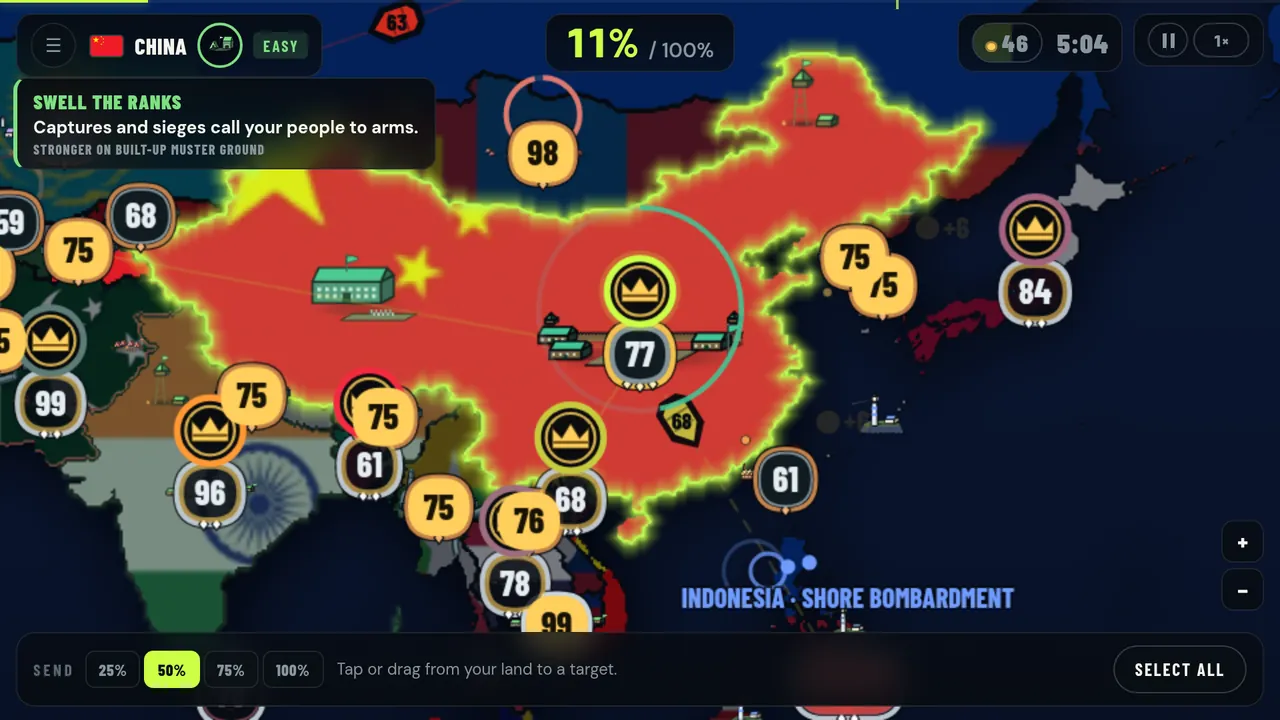
Hold 70% of the map for 15 seconds and every rival left standing surrenders. That's the win, and the clock stops at that moment. The time on the clock is your clear time, and it's what the daily board ranks.
A line along the top of the screen shows your share of the map, with a mark at 70%. You don't need to take every province, and you don't need to knock out every nation. Most wars are won by taking a few big neighbors and their land, then holding.
You lose if your capital falls and you don't take it back before its countdown runs out.
Sending troops
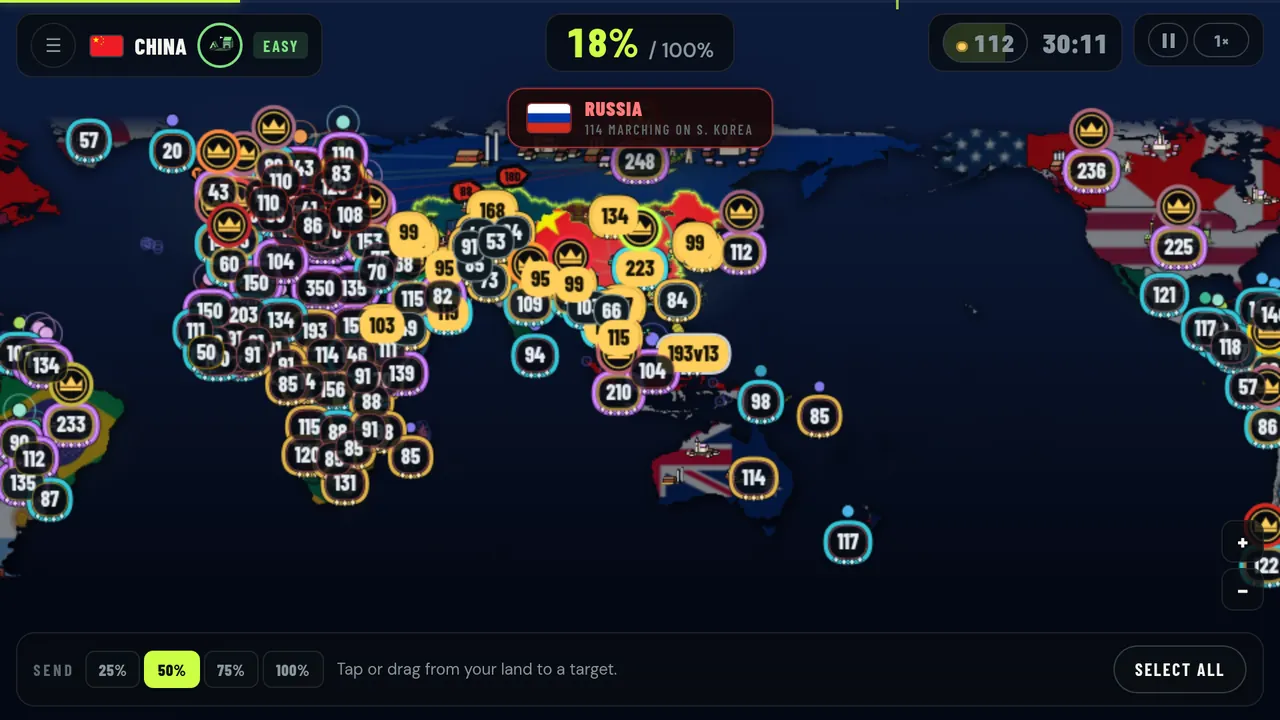
Tap or drag from your land to a target. Your troops march there and fight in real time. They find their own path through land you hold, so you can send from a province deep in your territory to a front far away.
- Send from several provinces. Tap SELECT MORE and then each province you want to send from, or hold Shift and click on a computer. SELECT ALL sends from every province you hold. Tap it again to deselect.
- Lock a target. Double-tap a province to lock on it. Your selected provinces keep sending troops there until you release it. You can lock more than one target to fight on several fronts at once. To release a lock, tap the target again, press Esc, or tap the LOCK chip.
- Choose how much to send. The SEND setting (25%, 50%, 75% or 100%) decides how much of each garrison leaves and how much stays home. Leaving something at home matters on a border where a rival is waiting.
- Crossing water. Provinces connected by a sea lane can attack each other across the water. Sea crossings take time, and some nations are much faster or much slower at sea (see traits).
How fights work
When an attack reaches a province, both sides lose troops until one runs out. If the attackers outlast the garrison, the province is yours, and the survivors become its new garrison.
- Ties go to the defender. Send a little more than you think you need.
- A big enough army breaks a garrison faster. An outnumbered garrison loses troops faster than it would in an even fight, so three-to-one wins quickly while a narrow edge grinds.
- Capitals defend harder than ordinary provinces.
- Ground keeps its character. A province you capture keeps the development it had, minus one tier, so a built-up province is worth fighting over.
Capitals and kills
Every nation's starting province is its capital. Take a rival's capital and hold it until the countdown ends, and that nation surrenders. All of its provinces join you at once. This is the fastest way to grow, and it's why a capital next to you is usually worth more than three neutral provinces.
The same rule works against you. If your capital falls, a countdown starts. Take it back before the countdown ends or the war is over for you.
Every nation you knock out counts as a kill. Kills have their own rankings, separate from clear time.
Gold and building
Fighting earns gold. Captures, kills and time survived all pay it. You spend gold province by province to develop your ground.
Select a province you hold and tap DEVELOP to see its track. Each province climbs five tiers, and the costs go up steeply: 35, 80, 150, 250 and then 400 gold. A full province costs about as much gold as a whole winning war earns, so most wars develop a handful of key provinces rather than everything.
What a province becomes depends on the country it really is, not on who owns it. Take Germany's province and it develops as Industry, whoever you are. There are six kinds of ground:
- Fortress (bastion nations): stone walls and keeps that make the garrison bigger and harder to break.
- Industry (industry nations): workshops and factory lines that raise the garrison and pay gold over time.
- Naval (blue-water nations): harbors and drydocks for war at sea.
- Muster (manpower nations): muster grounds and conscription that put more troops in the field.
- War Camp (horde nations): camps and raider lodges built for attacking.
- Frontier (vast nations): supply depots and granaries for holding a lot of ground.
The first two tiers are the same for every province of a kind. At tier 3 most kinds split into two doctrines. A Fortress, for example, can become HOLD THE ROCK, which makes that one province far harder to take, or SHIELD THE REALM, which spreads its defense to the provinces around it. Tiers 4 and 5 belong to the doctrine you chose, and tier 5 is a capstone with an ability of its own. Naval and Muster ground climbs a single line instead.
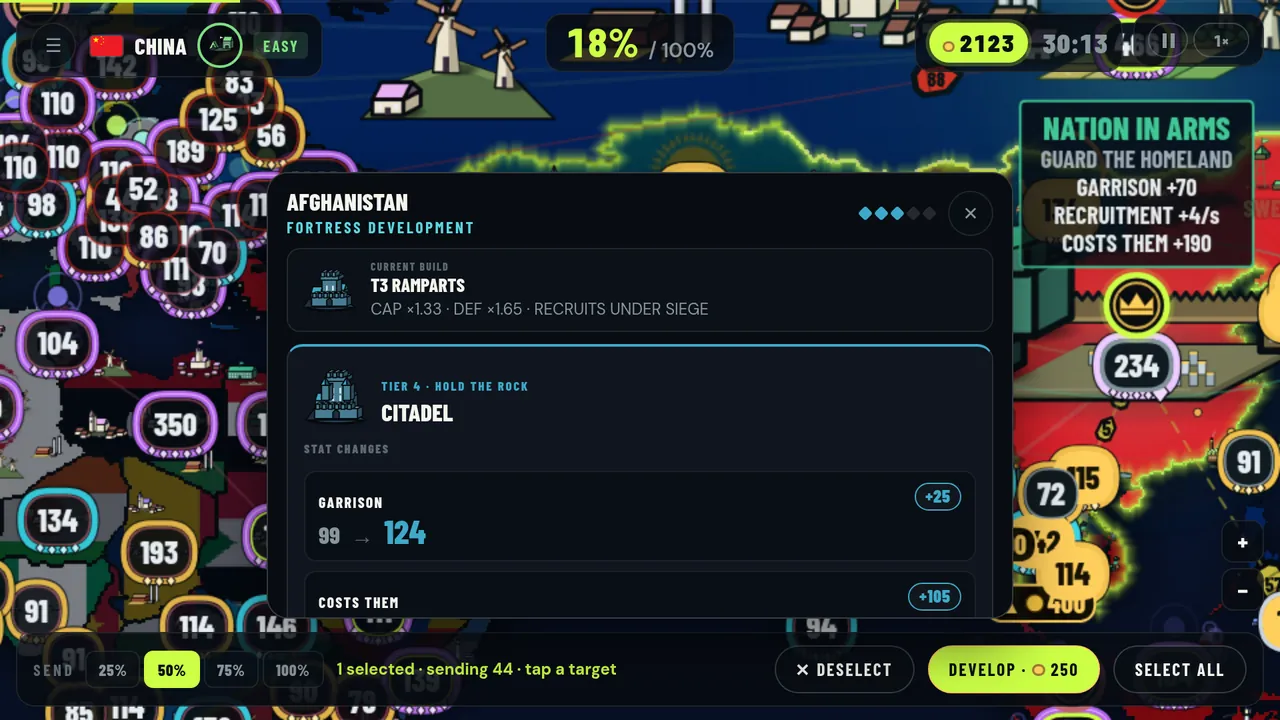
If you're far behind, building costs less. That's the game's comeback rule: a nation that's losing can still build its way back into a war.
Nation traits
Every nation has one strength, one weakness and a weight class. The strength is a rule the game runs on its own. You never press a button for it, and the AI nations you fight have theirs too.
| Industry: War Machine | A province that has just held off a siege, or has just been taken, recruits several times faster for a few seconds. |
|---|---|
| Vast: Occupation | Ground a rival takes from you stops recruiting and bleeds troops. If it bleeds out, it flips back to you, and while it's occupied you retake it at half its defense. Never applies to a capital. |
| Manpower: Swell the Ranks | Captured provinces start with extra troops on top of the survivors. When a siege opens on your province, its people take up arms at once. |
| Bastion: Stonewall | When a siege opens on your province, the garrison takes no losses for a moment while it keeps killing. |
| Blue Water: Shore Bombardment | Your coasts shell the weakest hostile province across the water every few seconds. Your landings soften their target, and enemy landings on your coast are shelled on the way in. |
| Horde: Blitz | Every capture knocks troops off the hostile provinces next to it and stops them recruiting for a few seconds, so a chain of captures gets easier as it goes. |
Weaknesses
- Coveted: rival nations pick your ground first.
- Sparse: smaller garrisons everywhere.
- Plains: your defenders break early.
- Brittle: provinces refill slowly after a fight.
- Landlocked: sea crossings are slow.
Weight class and challenge rating
A nation's weight class sets the size of its garrisons and how fast they refill: world power (the United States, Russia, China and India), major power, regional power or underdog. It applies to the AI nations too, so the map has real great powers on it.
Each nation also carries a challenge rating from Easy to Extreme. It describes how hard that nation is to win with, given where it starts and what it's good at. It isn't the difficulty setting. You can play any nation on any setting. Every nation has its own page in the nation list.
Difficulty
Difficulty is a setting you choose for each war: Easy, Medium, Hard or Extreme. It changes how sharply the enemy commanders play, how long they leave you alone at the start, and how hard neutral ground resists. It never gives the AI extra troops. Nations differ in where they start, who they border and how they fight, never in how hard the war is.
The small number on each difficulty button is that setting's live win record from real players.
The daily war
Every day the whole world plays the same war: the same map and the same nation. The daily always runs on Easy, so it's winnable every day, and the contest is the clock. The fastest clear time tops the day's board.
The daily tours the boards through the week. The world map comes up regularly, and so do the regional maps: Africa, the Americas, Asia, Europe and the United States, plus the continents board. Each map's nations take turns, and none of them repeats until every nation on that map has had its day. The daily changes at midnight UTC.
A war you paused doesn't go on the day's board.
The campaign
The Long War is a campaign of operations that unlock in order, from small regional boards up to the whole world. It's a route through the game, not a gate: every board, every nation and every difficulty is open to you in free play from the start. Veteran runs the same operations in the same order with every war one difficulty harder, and keeps its own clears and best times.
Rankings, medals and seasons
- Daily board: today's war, ranked on clear time.
- Weekly board: every daily war you play in a week adds to your score for that week, so playing each day's war matters as well as playing it fast.
- Kills board: the nations you've knocked out.
- Medals: win as a nation on a map to earn its medal there. Bronze on Easy, silver on Medium, gold on Hard and master on Extreme. Your best time is kept with each one.
- Seasons: each calendar month is a season with its own era and look. The season board ranks daily wars won and starts over every month, and where you finish becomes a ribbon you keep.
Every war you fight to an ending earns laurels, a win earns more, and a new medal earns a lump. Laurels buy looks, the themes that change how the game is drawn. They never touch a war: no troops, gold, speed or board place.
Playing with friends
Choose PLAY WITH FRIENDS and make a new room. Share the room code, and everyone who joins picks a nation. The AI takes every nation nobody picked, and the war runs live for everyone in the room.
Speed, pause and keys
Pause or change speed from the top bar. You can still select, send and build while paused. Speed goes 1×, 1.5× or 2×. On a keyboard, Space pauses and S changes speed.
The game saves your progress in your browser. Make an account (on nationsroyale.com, free and optional) to keep it on any device.
That's every rule. The fastest way to learn the rest is one war on Easy.
Play nowNext: strategy tips for winning faster, or browse all 48 nations.
Last updated November 5, 2026.